
Welcome to Bunyip North Energy Storage
A new energy storage project in Australia
The following FAQs were first published in January 2026 and expanded in August 2026 to respond to questions raised by the community during the public notice period.
New in August 2026:
- How to have your say - the application is now on public notice, with all documents on the Ministerial permit register
- Fire safety and emergency response - what happens if a battery catches fire and how emergency services would respond
- Noise - what the project is predicted to sound like at nearby homes, how noise limits are set, and how background noise was measured locally
- Farmland - the findings of the independent agricultural assessment
- Protected species and waterways - how the ecology assessment addressed Cannibal Creek and threatened species
- Data centre - confirmation there is no data centre in RES's plans for this site
- Enforcement - how permit conditions and management plans ensure commitments are delivered
The planning process and having your say
How can the community have a say on the Project under the Development Facilitation Program (DFP)?
The planning application is now on public notice.
The full application and all supporting technical reports are available on the Ministerial permit register. During the public notice period, anyone can make a submission. Visit PA2604370 to review the application.There are two ways you can make a formal submission about the project during the public notice period, by 21 August 2026:
- Via post to the Minister for Planning, C/ Department of Transport and Planning, GPO Box 2392, Melbourne VIC 3001
- Via email: energyandinfrastructure@transport.vic.gov.au
The Responsible Authority will not decide on the application before 21 August 2026. The public notice process is managed by the Department of Transport and Planning, and all submissions are considered by the Minister for Planning before any decision is made.
To learn more about the planning process, visit Planning Pathway & Timeline.
How are a BESS project’s impacts regulated, and what ensures the commitments are delivered?
The potential impacts of a battery energy storage project are assessed through the planning permit process against Victorian planning requirements, relevant Australian Standards and regulatory guidelines. For example, noise must comply with the EPA's Noise Protocol (Publication 1826.5), and fire safety design with the CFA's Design Guidelines and Model Requirements: Renewable Energy Facilities. Independent technical assessments addressing each of these matters form part of the planning application, demonstrating how the project will meet these requirements.
If a permit is granted, these requirements are carried through as conditions of the permit - meaning the project cannot lawfully be constructed or operated without complying with them. During detailed design, compliance of the final design must be validated against the applicable controls, and detailed management plans must be prepared setting out how measures will be applied in practice through construction and operation. These typically include:
- a Fire Management Plan and an Emergency Plan, prepared in consultation with the CFA
- Environmental Management Plans for both construction and operations, detailing how the project will manage noise, lighting and other impacts to protect local amenity
- a Drainage and Stormwater Management Plan
- a Traffic Management Plan.
These plans must be endorsed by the responsible authority before construction can commence, and the permit conditions remain in force for the life of the project.
Noise and lighting
What will the Bunyip North BESS sound like at nearby homes?
An independent noise assessment of the project by ERM has been completed and is available for review on the Ministerial permit register. Accounting for the noise predicted from the project, it concludes:- The project will not result in exceedance of noise limits at any residence.
- Predicted noise, even at the nearest dwellings, remains at least 5 decibels below the applicable limits.
- The maximum predicted noise level is 40 dB during the day and 36 dB in the evening and at night at the nearest dwellings, the nearest being approximately 480 metres from project infrastructure.
For context, 40 dB is comparable to a quiet library or a refrigerator hum in another room. The World Health Organisation advises a noise level of 45 dB outside bedrooms with the window open to prevent sleep disturbance.
Interpreting noise findings:
- Noise drops away rapidly with distance - homes further away will experience less than those nearer.
- Noise is measured on a decibel scale, so contributions do not simply add together - doubling the number of identical noise sources adds about 3 dB, not double the noise.
- Background sound has a masking effect - in practice, adding a source that is 10 dB or more below an existing level makes no significant difference to what is heard.
Achieving this buffer below the limits reflects a design approach for the Bunyip North BESS that prioritises noise minimisation through the selection of quieter equipment and the siting of noise-producing equipment away from surrounding dwellings.
How are noise limits set, and has background noise been measured at local properties, including noise carried on the wind?
How noise is assessed and regulated
Noise from projects like this is regulated by Victoria’s Environment Protection Authority (EPA). Its Noise Protocol (EPA Publication 1826.5) sets the method and measurement procedure used to determine the applicable noise limits and to assess compliance for proposed developments. Limits for day and night apply at each noise sensitive location nearby (such as residences), based on local zoning and existing background noise. Because the limits are derived from the existing environment, a quiet rural setting produces stricter limits than an urban or industrial one. The assessment also includes adjustments for noise character, with penalties for noise that is impulsive or tonal.
A proposed development is not compliant by law unless the noise predicted at all receptors remains below these limits once noise from the proposed development is accounted for. If a permit is granted, noise compliance will be an enforceable condition for the life of the permit.
Background noise monitoring at local properties
ERM undertook unattended noise monitoring at three locations around the project over multiple days, in accordance with the Noise Protocol, to measure the existing background noise environment and derive project-specific limits.
The monitoring uses the LA90 measure - the level exceeded for 90% of each hour - which captures the underlying ambient environment rather than one-off events. A short, loud occurrence (a passing tractor, a barking dog) affects only a few minutes of an hour and therefore does not shift the level exceeded 90% of the time; the hourly results are then averaged across the full multi-day monitoring period, so unusual events cannot drive up the background level.
The environmental noise modelling explicitly accounts for meteorological effects, including wind, alongside geometric spreading, ground effects, shielding from topography and atmospheric absorption. The predicted levels at the nearest dwellings therefore already reflect noise-enhancing conditions relevant to the actual site and its surrounds.
Why are noise figures of 70–92 dB sometimes quoted for BESS?
Noise figures sometimes quoted for battery equipment - typically between 70 and 92 dB - are measured one metre from an active component, such as an inverter or cooling fan, and are comparable to standing beside farm machinery or a large air-conditioning unit. Those figures describe the equipment itself; they are not the level heard beyond the site. Sound reduces rapidly as it travels and is further influenced by terrain, ground cover and distance. For that reason, noise is assessed and regulated at the places where it is heard - such as nearby residences - rather than at the equipment or the site boundary.
How will night-time lighting be managed?
Outdoor lighting at the site must comply with Australian Standard AS/NZS 4282, which limits light spill, glare and sky glow from developments. The standard categorises locations into environmental zones, with stricter limits in sensitive, low-ambient-light environments - so a rural Green Wedge location attracts tighter limits than an urban or industrial site. The current standard also recognises impacts on wildlife and ecosystems. Compliance will be a legally enforceable condition of any permit granted by the State Government, for the life of the project.
Safety and emergency management
How will fire risk be managed around the Bunyip North BESS site?
Managing fire risk is a key focus for the Bunyip North BESS. The site is located within a Bushfire Prone Area, which means bushfire risk must be carefully assessed and managed as part of the planning process.
A bushfire hazard assessment has been undertaken to assess the bushfire and grassfire risk from the surrounding landscape, determine how the design can prevent fires from starting on site, and minimise the chance of fire spreading.
The completed assessment, together with the project's Risk Management Plan and Fire Safety Study, forms part of the planning application and is available for review on the Ministerial permit register.
Informed by national and international best practice and the CFA’s Design Guidelines and Model Requirements: Renewable Energy Facilities v4 (2023), measures in place for both construction and operation include:
- Vegetation management and firebreaks: A maintained non-combustible zone around infrastructure, with separation distances sized to manage radiant heat and flame contact, and ongoing fuel-load management including grass maintained at or below 100 millimetres during the declared Fire Danger Period.
- Site layout and access: Perimeter and internal roads designed to support CFA access, with multiple entry points for flexible emergency response.
- Firefighting water supply: At least 576,000 litres of dedicated static water storage, with a hydrant system designed to Australian Standard AS 2419.1.
- Monitoring and emergency response: 24/7 remote monitoring, alarms to a central control room, and emergency procedures developed in consultation with the CFA.
Together, these measures ensure the project is designed, constructed and operated to meet stringent fire-safety standards and support effective response by emergency services.
If a planning permit is granted, a Fire Management Plan and an Emergency Plan must be prepared in consultation with the CFA, endorsed before construction can begin, and maintained for the life of the project.
What happens if a BESS catches on fire?
Fires in battery energy storage systems are rare. Each battery unit continuously monitors cell temperature and voltage, with early smoke and gas detection, internal fire suppression and emergency shutdown controls that respond at the first sign of a fault, alongside explosion and ember protection.
If a fire occurs and is not fully extinguished by these systems, the battery enclosures are separated and fire-tested to international standards (UL 9540A) so that a fire in one unit cannot spread. The fire response strategy, developed with the CFA, is designed to contain any incident to a single enclosure. Emergency services typically allow the affected unit to burn out safely under controlled conditions while protecting nearby equipment.
What would the smoke contain?
In the unlikely event of a battery fire, the smoke would contain gases similar to those from other structure or vehicle fires, such as carbon monoxide, carbon dioxide and fine smoke particles, along with hydrogen fluoride, an irritant gas produced when lithium-ion battery electrolyte burns. These gases are hazardous close to the fire itself, which is why fire services establish exclusion zones and wear breathing apparatus, but they disperse and dilute quickly in open air.
The project proposes to use lithium iron phosphate (LFP) batteries, now the standard for grid-scale storage. LFP batteries are more stable at high temperatures than older lithium-ion chemistries and produce less gas and heat in the event of an incident. They also contain no nickel, cobalt or manganese, meaning a fire cannot release the heavy-metal particles associated with some older battery types.
Protecting waterways
Because the standard response is controlled burn-out rather than applying large volumes of water, little or no contaminated firewater is generated. BESS site design also includes stormwater controls and containment so runoff is captured on site rather than reaching drains, dams or waterways. Under the project’s Emergency Management Plan, any firewater present would be contained and removed by an accredited EPA contractor.
Protecting people and livestock
An Emergency Management Plan must be prepared in consultation with fire services and emergency authorities before the project could commence, as a condition of any permit. It details responses such as community notification through VicEmergency, air quality monitoring during any significant incident, and clear advice to nearby residents.
Battery fires at modern grid-scale facilities are rare, and the design standards relevant to the Bunyip North BESS are specifically intended to ensure that even a worst-case fire remains contained on site without harmful impacts to neighbours, animals or the environment.
If you’re interested in learning more about fire risk and renewable energy projects generally, you can read about it here: Do large-scale renewables pose a fire risk to communities? - Energy Fact Check
How would emergency services respond to an incident at the site?
Fire safety and emergency response are addressed as part of the Bunyip North BESS planning process. Fires at this type of facility are treated as industrial fires, and the CFA has established processes for responding including access to and use of equipment, coordination with neighbouring brigades and Fire Rescue Victoria, and communications to scale resources and response to suit the incident.
The CFA’s response would be supported by the site’s Emergency Management Plan and detailed site information available at the project entrance. An Emergency Information Folder kept at the front gate would include key site details, hazards, access information and a 24-hour contact number for the site operator, who would be able to:
- provide details about the site layout, equipment and any potential hazards to be aware of
- attend as a subject matter expert to support emergency services with site-specific technical information
- arrange additional specialist support, such as an electrician, if required.
The project has been assessed by independent fire specialists through a Risk Management Plan and Fire Safety Study, prepared in line with CFA guidelines for renewable energy facilities. If a planning permit is granted, a Fire Management Plan and Emergency Management Plan setting out site access, water supply, shutdown procedures, and roles and responsibilities must be prepared in consultation with the CFA before construction can start.
Environmental and cultural considerations
What are the environmental and cultural heritage considerations, including local waterways?
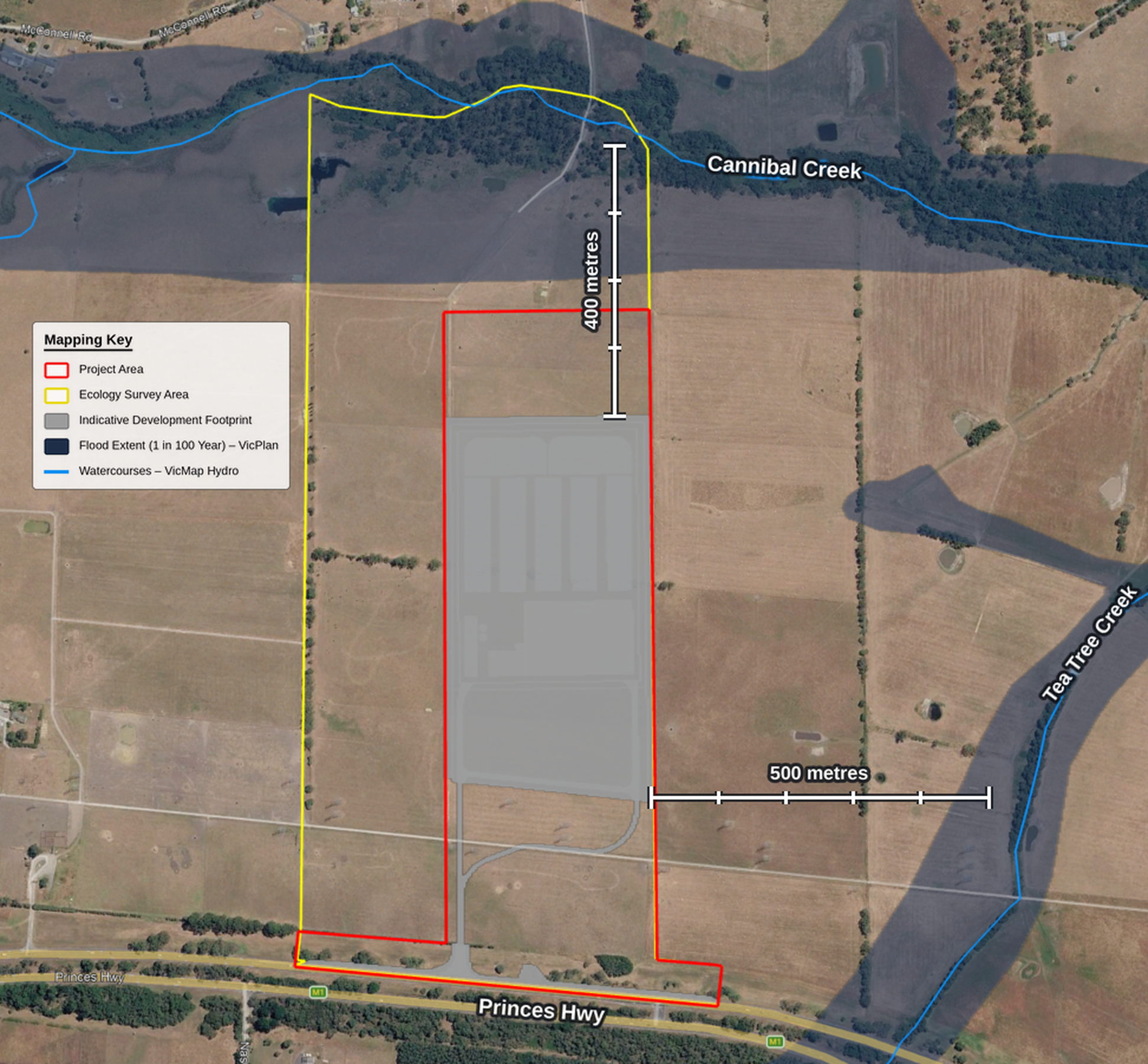
Independent ecological and cultural heritage assessments have been completed to understand how the project may affect local plants, animals, habitats, waterways and areas of cultural sensitivity. On-site surveys helped define a project area that keeps to mostly modified farmland and avoids native vegetation, wildlife habitat and culturally sensitive areas, including land surrounding Cannibal Creek to the north of the project site.
RES has engaged ERM to prepare a Cultural Heritage Management Plan in consultation with the Bunurong Land Council Aboriginal Corporation.
RES also referred the project to the Australian Government under the Environment Protection and Biodiversity Conservation (EPBC) Act 1999 (referral 2026/10492). The Government determined the project is not a controlled action, meaning it is not likely to have a significant impact on matters of national environmental significance and no separate Commonwealth approval is required.
There are protected species near the site, such as the Dwarf Galaxias and platypus. How are they protected?
Independent ecologists at ERM conducted ecological surveys and flora and fauna habitat assessments across the project area and beyond, including the Cannibal Creek corridor, to assess potential direct and indirect impacts. They found no threatened species or their preferred habitat within the project area itself. Within the wider survey area, they identified five threatened or migratory fauna species that are likely to occur - Dwarf Galaxias, Growling Grass Frog, Southern Brown Bandicoot, Glossy Grass Skink and Swamp Skink - along with one endangered flora species known to occur along the creek. Their potential habitat sits in the Cannibal Creek corridor and in farm dams outside the project area.
Several other species (including platypus) were also identified as having the potential to occur within this habitat. The protections applied are habitat-based rather than species-by-species, so they protect the creek and its aquatic values generally.
The findings are set out in the technical report accompanying the planning application, available on the Ministerial permit register.
Avoidance is the primary protection. To avoid impacts on threatened species such as the Growling Grass Frog, the Government’s Significant Impact Guidelines recommend a buffer of 200 metres from habitat as a minimum avoidance distance for all project activities. The project’s proposed infrastructure achieves a greater separation than this - more than 400 metres from Cannibal Creek.
Beyond avoidance, the site's drainage and stormwater design will incorporate measures such as on-site detention, sedimentation controls and shut-off valves, so water can be captured and tested before it leaves the site. That containment, combined with the separation distance above, protects the surrounding waterways.
During construction, further committed controls include erosion and sediment management, weed and biosecurity measures, and frog exclusion fencing.
These commitments are enforceable. They carry into the environmental management plans required under any permit, which must be endorsed before works can commence and remain enforceable for the life of the project.
How are Traditional Owners involved in the Bunyip North BESS?
RES acknowledges the Bunurong People of the Kulin Nation as the Traditional Custodians of the land on which the Bunyip North BESS is located. Traditional Owner partnership is a core part of how we develop projects. Our commitment to respectful and meaningful engagement is guided by RES’s Reconciliation Action Plan, which sets clear expectations for culturally informed planning, design and benefit-sharing.
Across all RES projects, this includes:
- cultural awareness training for our staff
- Indigenous procurement pathways and long-term partnership opportunities
- dedicated First Nations engagement leads within our teams
- support for education, employment, cultural initiatives and community programs
- benefit-sharing initiatives designed with Traditional Owners
The Bunyip North BESS is following this same approach through ongoing engagement with the Bunurong Land Council Aboriginal Corporation. This involvement will continue throughout planning, design and delivery to ensure Traditional Owner perspectives and cultural values are reflected in the project.
Project purpose and location
Why has the site been chosen?
The proposed location has been selected because it is close to a strong part of the Victorian electricity grid. This means the battery can connect efficiently to existing transmission infrastructure and help store and release electricity when it is needed, without requiring new long-distance powerlines to be built.
Why can a battery be proposed outside a Renewable Energy Zone (REZ), and does that mean planning rules or overlays can be ignored?
Battery energy storage systems (BESS) can be located either inside or outside Victoria’s Renewable Energy Zones. Their role is to support the wider electricity network by improving reliability, stability and the use of renewable energy. Projects outside a REZ are still required to meet strict grid-connection standards and demonstrate broader community and economic benefits.
Importantly, being outside a REZ does not mean planning rules or overlays can be ignored. Battery projects must comply with the relevant local planning scheme, satisfy all applicable overlays (such as flood, heritage or bushfire overlays), and undergo assessment by planning authorities. These requirements ensure that environmental, cultural heritage and community considerations are fully addressed.
Will productive farmland be lost, and can farming continue on the site?
We understand the importance of protecting productive farmland. An independent assessment by Pinion Advisory found the site is Class 3 grazing land with moderately productive soils that is not classified as strategic agricultural land or high-value irrigated land at either a regional or state level. Farming can continue alongside the project, and the assessment found there would be no long-term impact on soil productivity, meaning the project area could be returned to agricultural use at the end of the battery’s operational life.
The assessment is available for review on the Ministerial permit register.
How will the project support the electricity grid, and where will its power be used?
The project would connect into the National Electricity Market, which is operated by the Australian Energy Market Operator (AEMO), and be one of many resources supplying electricity into the system to support system-wide demand at a given point in time. Any load that is operating at a coincident time in Bunyip or the surrounds and is network connected adds to this system demand.
Beyond energy storage, BESS technology can also deliver system-strength services that improve grid stability by helping regulate voltage and frequency and may assist with grid restart following major outages.
Is a data centre part of RES’s plans for this site, now or as a future stage?
No. RES wants to address the concerns around this project and potential data centres, and can confirm it is not developing a data centre at this location. The Bunyip North BESS is a single-stage battery energy storage system (BESS) project. Its scope, layout and use are set out in the planning application, now on public notice. There is no data centre in RES’s plans for this site.
Community engagement and benefits
Is RES continuing to consult with the local community on the proposal?
Consultation and communication will continue beyond the public notice period and throughout the planning assessment process. While we work to reach as many people as possible, no single channel reaches everyone. The most reliable way to receive updates directly is to join the project mailing list via the Contact Us page.Since August 2025, engagements with the local community have included:
- letters to addresses within approximately 1.5 kilometres of the site, in August 2025 and March 2026, with further letters in June 2026 notifying near neighbours of the public notice period
- the project website, live since August 2025, with email and phone contacts for the team and a registration form for direct project updates to subscribers - visit Contact Us
- an in-person presence at three local community events in October 2025, January 2026 and March 2026
- advertisements in three local newspapers - the Warragul & Drouin Gazette, the Pakenham Gazette and the Bunyip & District Community News
- more than 1,200 newsletters delivered to local mailboxes in October 2025
- a community information session at the Bunyip Hall in July 2026
Alongside community engagement, RES continues to consult with key statutory authorities - including Cardinia Shire Council, the Bunurong Land Council Aboriginal Corporation, CFA, Melbourne Water, AusNet and AEMO - to ensure the Project is developed safely, responsibly and in line with local and state requirements.
We are committed to maintaining open lines of communication and ensuring the community remains informed throughout the development, assessment and, if approved, delivery of the project.
How will benefit-sharing be developed for the Bunyip North BESS?
RES has engaged ERM to prepare an independent Social Impact Assessment (SIA) for the project. The SIA is currently underway and draws on input from local residents, community organisations and service providers to understand how the area functions today, what matters most locally, and where a project of this kind could make a meaningful contribution. Its findings will inform the proposed Community Benefits Fund, and Social Value and Economics Plan.
The findings of the SIA will be shared with the community before further consultation on how the benefit-sharing program should be shaped.
To learn more about the benefits of the Bunyip North BESS, visit Project Benefits.
Will this cause property values to decline?
Battery Energy Storage Systems (BESS) are generally much smaller in scale than wind or solar farms. Studies into the effects of renewable energy developments on property values have been undertaken for larger-scale projects, such as wind and solar farms, and are summarised in this Clean Energy Council fact sheet: Renewable Energy, Property Prices and Insurance.
A 2022 market report cited in this fact sheet found that median property prices in six New South Wales and Victorian local government areas with major renewable projects increased by 35–51% over five years. Based on this data and the smaller footprint and impact of a BESS, it is not expected that the proposed project at Bunyip North will impact on property valuations in the Bunyip North area.
Project timeline, ownership and end of life
What is the expected timing for a battery energy storage project?
A battery project typically progresses through three main stages:
- Development (around 2–4 years): Site assessments, engineering design, community engagement, planning and grid connection approvals.
- Construction (around 12–24 months): Site preparation, installation of civil and electrical works, delivery of battery units and connection to the grid.
- Operations (20–30+ years): The facility supports the electricity network through its operational life, with regular monitoring and maintenance. At end-of-life, equipment is removed and the land can be restored.
Who will own and operate the Bunyip North BESS, and what is RES’s role?
RES’s role is to develop the Bunyip North BESS, which includes site selection, environmental and technical assessments, planning and regulatory approvals, grid connection work and community engagement.
Once development is complete, a long-term owner and operator - such as an energy company, utility or infrastructure investor - is expected to purchase the project and take responsibility for operating it over its life.
While RES does not plan to be the long-term owner, we can provide construction and asset management services if engaged by the future owner, offering continuity from development through to construction and operations.
All commitments made during development - such as planning permit conditions, environmental protections, cultural heritage requirements, safety standards and benefit-sharing - remain legally binding on any future owner or operator.
What happens at the end of a battery energy storage project’s life, and how is recycling managed?
Battery energy storage systems are designed to operate for around 20–30+ years. At the end of their operational life, the facility is decommissioned, which involves safely removing all above-ground equipment and restoring the land to its original use unless otherwise agreed with the landowner.
Battery components contain valuable and recyclable materials. As the industry grows, recycling technologies continue to advance, enabling increasing recovery of metals and other materials. End-of-life processes follow strict safety, environmental and waste-management regulations.
For more information on battery recycling in Australia, see the Clean Energy Council’s fact sheet below.
Click to view Factsheets by the Clean Energy Council below.